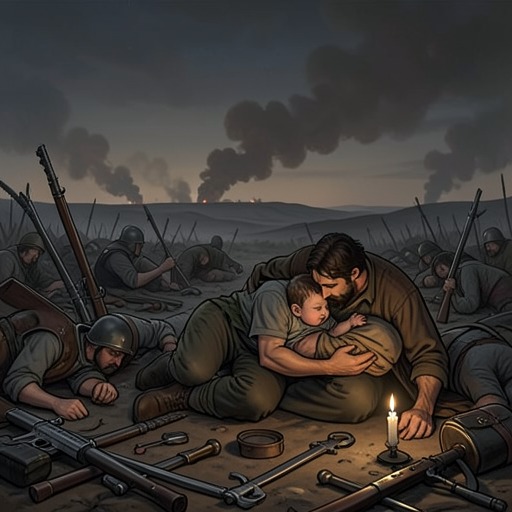
France's Wartime Devastation
Henry VFrance's Wartime Devastation is rendered as a country losing the care that makes fertility useful: vineyards go unpruned, fields become overgrown, and the arts of settled life give way to habits shaped by bloodshed. The damage is at once agricultural, social, and political. Against the campaign's grand claims and military spectacle, the neglected landscape makes visible what prolonged war does to the ordinary conditions of peace.
A Fertile Country Without Peace
In a formal appeal before a royal audience, the Constable of France asks what obstacle prevents Peace from appearing in France, described as the world's best garden. The question makes the devastation more than a battlefield condition. Peace is imagined as a vulnerable figure driven out of the country, while French husbandry lies in heaps and fertility itself no longer guarantees flourishing. The image turns a celebrated productive landscape into evidence of neglect: the country has the means to thrive, but not the security or care required to do so.
This contrast is sharpened through the details of cultivation. The vine, associated with cheer, dies without pruning; orderly hedges grow wild, likened to prisoners whose hair has gone uncut. The comparison shifts attention from an abstract national calamity to visible signs of lost maintenance. The land has not simply ceased to produce. Its useful growth has become disorderly because the work that once shaped it is no longer being done.
From Fields to Waste
The same reversal appears in the meadows. Where cowslip, burnet, and green clover once grew, the missing scythe leaves vegetation unchecked; docks, thistles, kecksies, and burs take over. The passage names both beauty and utility as losses. Its catalogue distinguishes a cultivated field, valued for what it can nourish and offer to the eye, from a field whose abundance has become rough and unusable. Fertility persists, but its character has changed: without care, growth becomes part of the damage.
The image extends across vineyards, fallow land, meadows, and hedges, gathering different parts of the rural environment into one account of decline. These are not presented as isolated casualties of a single assault. Their shared condition is neglect and wildness, a cumulative alteration that has become visible in the everyday landscape. The speech thus slows the movement of a war narrative to make the consequences legible in things that would otherwise form its background: a vine left unpruned, a rusting ploughshare, a meadow no longer cut.
The Damage Enters Domestic and Civic Life
The Constable carries the comparison from the land to people. Houses, adults, and children, he says, have lost or failed to learn the sciences that would form their country, for want of time. The argument is not merely that war destroys property. It consumes the time needed to pass on knowledge and sustain civic life. The country’s cultivated fields and its cultivated capacities are placed in parallel: both depend on practices that cannot flourish when attention is continually drawn elsewhere.
Soldiers who do nothing but meditate on blood become the sharpest example of that displacement. The resulting habits include swearing and stern looks, with dress described as diffuse. The shift from the shape of the hedges to the bearing of people makes the image of wildness social as well as environmental. Military life does not remain confined to the army; in this account, its preoccupations press into the manners and education of the country. The speech therefore treats devastation as a loss of beauty, usefulness, knowledge, and disciplined conduct together.
Campaign and Cost
The wider campaign supplies the military context for this diagnosis. Earlier, the Archbishop of Canterbury urges King Henry V to press his claim in France, calling for English bodies to follow there with blood, sword, and fire, and recommending that a quarter of England accompany the king. The forceful language presents invasion as a means of winning a right; the later appeal for peace exposes another measure of what such a project places at stake. The two speeches do not offer a neutral account of responsibility, but their contrast brings military purpose and national cost into the same dramatic frame.
The siege of Harfleur gives that campaign a concrete form: the audience is asked to imagine ordnance on its carriages, aimed at the town. Later, Montjoy carries the French king’s message to King Henry V, explaining that the French had seemed dead but had only slept, and that advantage is a better soldier than rashness. In the same exchange, the French king acknowledges that sickness has weakened his people and reduced their numbers. This report concerns an army in the immediate contest, not a complete inventory of France’s condition; set beside the Constable’s account of deserted cultivation and interrupted learning, however, it shows how the play places military vulnerability within a country already figured as deprived of peace.
France's Wartime Devastation is consequently more than scenery behind a contest for territory. Its damaged vines, rank meadows, neglected households, and threatened education make war's cost visible in the slow undoing of practices that sustain a country. The central irony is that abundance alone cannot protect a fertile land: without peace, cultivation becomes overgrowth, and a nation’s resources persist in forms that no longer serve beauty, livelihood, or shared knowledge.